Blog · Baizhan Kanafin
What I would study if I were twenty again
Talk materials: five prompts · a task for an agent · slides
The more I work with artificial intelligence and agents, the more clearly I see how much our approach to knowledge has to change. I don't mean individual subjects or professions, but knowledge in general: why we acquire it, where we keep it and what we do with it.
When I was twenty, everything was simple. Knowledge was scarce, and it took years to acquire. I wanted to become the strongest engineer in my field and saw one path: a degree, another degree, certificates, more knowledge. Whoever knew more was stronger.
Today any student gets, in half a minute, an answer I would have spent a semester on. But even that is no longer the main thing. The main thing has happened in the last year or two: AI stopped just answering. It started doing.
What is happening now
In simple terms. A chatbot answers a question. An agent gets a task and decides for itself how to carry it out: it searches, reads, writes, runs programs, checks itself and brings back the result. Anthropic, one of the companies that build such models, described the difference clearly: an agent runs the work itself and chooses its own tools, rather than following a pre-scripted path.
The tasks an agent completes without a human are quickly getting longer. Researchers at METR measure it like this: how long such a task would take a specialist. A few years ago it was seconds. Today it is hours, and the span keeps growing.
The next step is already under way: several agents work on one task. A lead agent plans and hands out parts of the work, the others search for and analyze materials in parallel, and one of them checks. Anthropic has described in detail how it built such a system for research tasks. In our company we are restructuring work the same way: agents have different roles, and a person sets the task and accepts the result.
Andrej Karpathy, one of the best-known AI researchers, called this a new era of programming last year: computers are now given tasks in ordinary human language. A well-formulated task becomes a program.
I open AI several times a day myself, before breakfast even. And what I use every day did not exist six months ago.
What this changes about knowledge
This is where I began to look at knowledge differently. When we started deploying agents in our own company, a simple thing became clear: an agent works exactly as well as the knowledge it has been given. Everything that had lived in people's heads for years had to be written down: how we answer customers, how we prepare proposals, what is allowed and what is not. And that turned out to be harder than it seems. Knowing something and being able to explain it are different things. Anthropic calls this context engineering: an agent does not need everything at once, it needs knowledge precisely selected for the task.
I drew three conclusions from this.
First. Knowing more than others is no longer an advantage: everyone has the answer. The advantage now is understanding a subject well enough to set a task, explain it to someone else — a person or an agent — and check the result.
Second. You need more knowledge of your subject, not less. AI makes mistakes confidently: it writes falsehoods in the same calm tone as the truth. Only someone who knows the subject can notice. Physics, mathematics and your specialty are what you check the machine with.
And third, the most important. What matters is not whether you have AI, but how you learn with it.
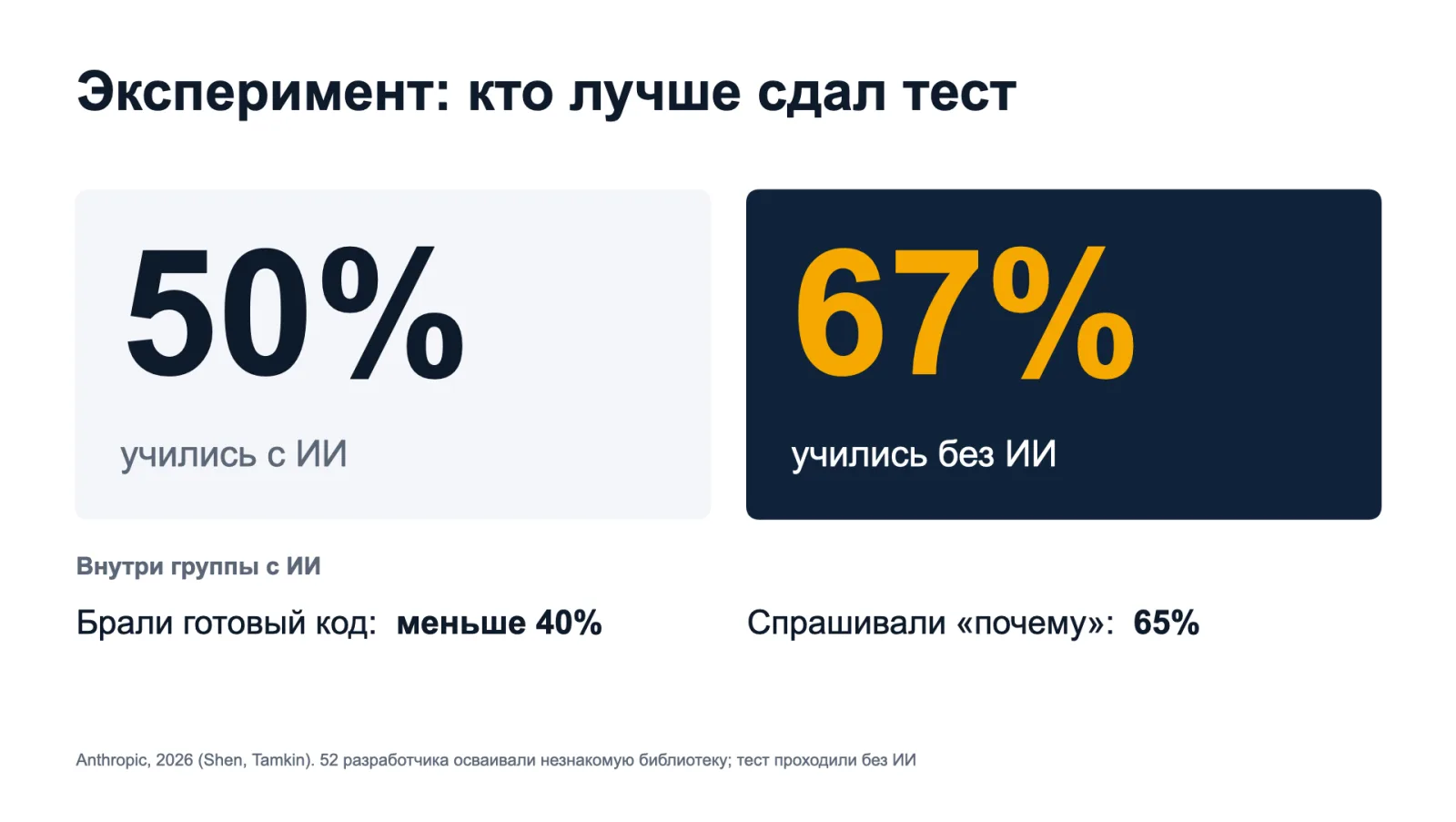
In January this year, Anthropic ran an experiment. Junior programmers learned a library that was new to them: half with AI, half without. Then everyone was tested without AI. The AI group learned less. But there was a difference within it: those who simply took ready-made code understood the least, while those who asked “why is it done this way” and asked for explanations understood noticeably better.
An experiment with school students in Turkey showed something similar. A regular chatbot helped them during practice, but on a test without it they did worse than those who had never seen AI at all. Those who got hints from AI instead of ready-made answers lost nothing. At Harvard, physics instructors built their own AI tutor, and students learned more, and faster, with it than in a good classroom session.
At the end of October, at Stanford, I attended a lecture by neurobiologist Kang Shen on human intelligence in the age of AI. His main idea: the brain becomes what it practices. Every time we decide what to hand over to AI, we decide which of our skills will grow and which will fade.
The tool is the same. The result depends on how you work with it.
What this means for work
Stanford economists are looking at payroll data in the US. They see no mass layoffs because of AI. But in occupations where AI takes over routine work, fewer young specialists are being hired. Junior programmers and customer support agents were the first to feel it.
I see the same thing. “Do it by the ready-made instructions” work is going to agents. What remains is the work of a person who sets the task, checks the result and is responsible for it.
And this is not only about IT people. When the electric motor appeared, factories at first simply put it where the steam engine had been and for a long time got almost nothing out of it. The payoff came when the workshops were rebuilt around the motor. The economist Paul David described this story back in 1990. The same thing is happening with AI now, and the rebuilding will be done by people who understand both their own field and agents.
This is my forecast, not research — it is what I see in my clients and in my own company. In five years, a business that has not learned to work with AI will leave the market. And one that has learned will hire fewer and fewer new people: the people it already has, plus agents, will be enough. So the window is open now. Two or three years. You are the generation that still has time.
What I would do in your place
If I were twenty today, I would study three things.
Your own subject, in depth. It is the only way you will be able to check the machine.
How an agent works: a model, instructions, a knowledge base, tools and permissions — what it may and may not do. And how several agents work together on one task.
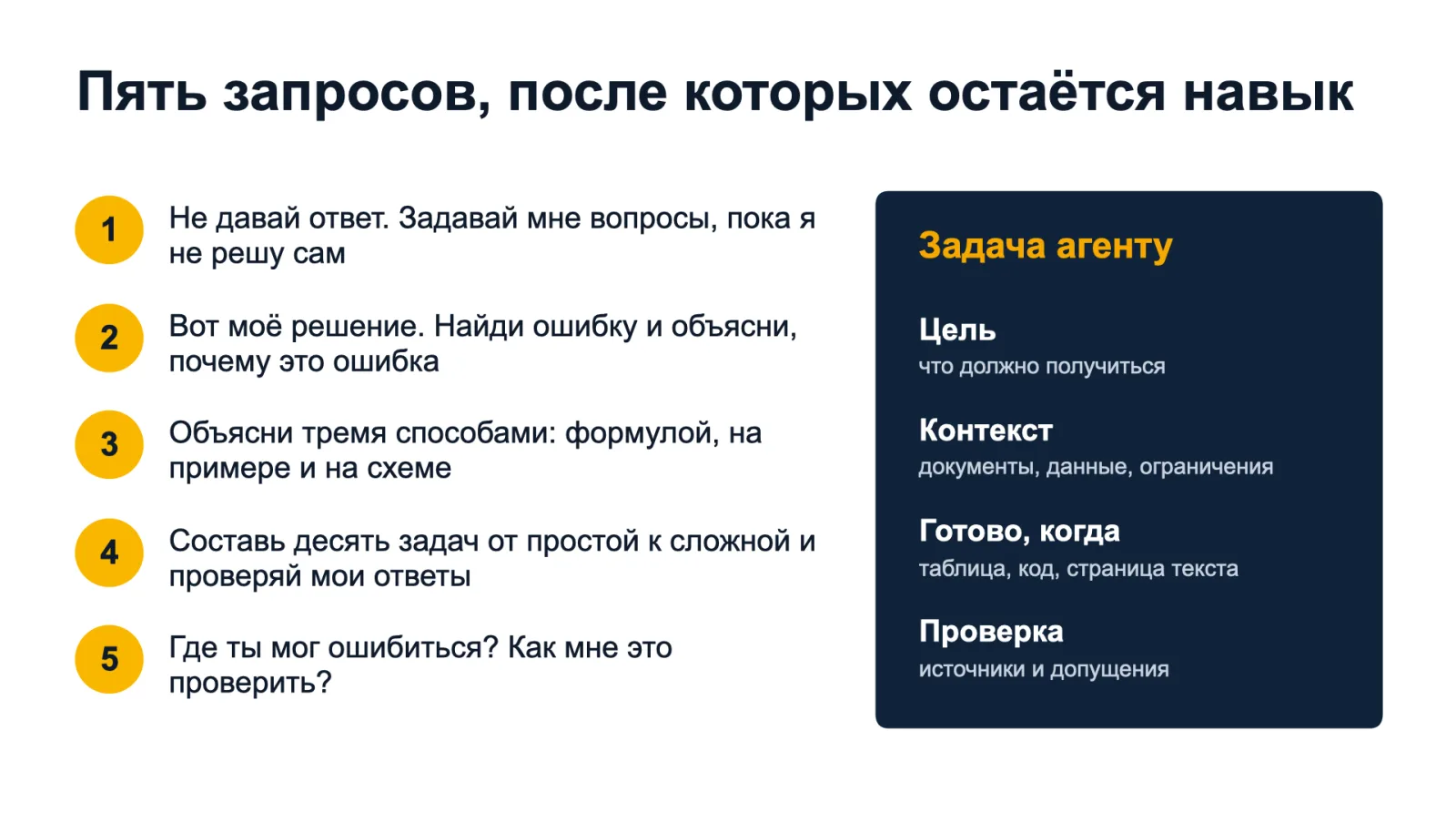
How to set a task. A good task has four parts: the goal, the context, what counts as done and how to check the result.
Don't get attached to a specific program. In six months something new will appear. The principle will remain.
And I would start with two assignments.
For this week. Take your hardest subject. Gather your materials for it: lecture notes, the textbook, problems, exam questions. Upload them to any tool that lets you work with your own materials, and ask it not to answer you, but to question you. For example:
Don't answer me. Ask me questions on this subject one at a time, check my answers and show me where I don't understand.
A week later, test yourself: can you explain the topic to a friend without your phone?
For the next three months. Find one person with a real problem: a relative with a shop, an entrepreneur you know, your own department. Ask what they are struggling with. Almost always you will hear one of three things: how to attract customers, how to sell, how to understand what is going on in the numbers. All of this can already be done with AI today. Solve that problem all the way, so that the person actually uses the result. Not a mock-up and not a presentation, but something that works. Three problems like that will tell an employer more about you than a degree and ten certificates.
While you work, keep three rules in mind. Yourself first, then AI. Ask “why”, not “what”. And practice without AI, like pilots: autopilot has been around for a long time, yet they are still made to fly by hand. On the day the automation fails, there has to be someone in the cockpit who knows how.
An AI answer is not the end of the work but its beginning. In our company the first answer counts as a draft. I set a task, get an answer and ask: why did you decide that? Where does this figure come from? What did you assume? Where could you be wrong? Then I correct it and ask more precisely. Sometimes five rounds, sometimes ten. The way you ask is what you get. And the way you correct it is what the result will be.
Knowledge is no longer scarce. What is scarce now is people who can turn knowledge into results and answer for them. You have a tool that no generation before you had. Let it be your tutor, not your crutch.
— Baizhan Kanafin
Five prompts that leave you with a skill
You can put this to use tonight. Copy a prompt and send it to AI together with your materials: lecture notes, a problem, your solution.
Don't give me the answer. Ask me questions until I work it out myself.
Here is my solution. Find the mistake and explain why it is a mistake.
Explain it in three ways: with a formula, with a real-life example and with a diagram.
Write ten problems on this topic, from easy to hard. Check my answers one at a time.
Where could you have gone wrong in this answer? How can I check it?
An ordinary question gives you an answer. These prompts make you think. Same time, different result.
Task for an agent
When you give AI a task rather than a question, it should have four parts.
- Goal
- What should come out of it, and for whom.
- Context
- Documents, data, constraints. The agent does not know what you have not given it.
- What counts as done
- A spreadsheet, working code, a one-page text.
- How to check
- Ask it to show its sources and list its assumptions.
A template so you don't miss any part:
Goal: …
Context: …
Done when: …
How to check: show your sources and list your assumptions.
Talk slides
AUPET, Almaty, 25 November 2026.

What to read
The materials are in English, except for the Bureau of National Statistics table.
- Anthropic · Building effective agents — how an agent differs from a chatbot and from a pre-scripted workflow. December 2024.
- Anthropic · How we built our multi-agent research system — how a lead agent hands out work to other agents. June 2025.
- Anthropic · Effective context engineering for AI agents — why an agent needs not all knowledge, but precisely selected knowledge. September 2025.
- METR · Measuring AI ability to complete long tasks — how the length of tasks an agent completes on its own is growing. March 2025, the page is updated.
- Andrej Karpathy · Software Is Changing (Again) — a talk on the new era of programming, video. June 2025.
- Anthropic · How AI assistance impacts the formation of coding skills — an experiment with 52 developers, mostly junior. On the test without AI, the group that learned with AI scored 50% on average, the group without AI scored 67%. Those who handed code writing over to AI scored below 40%; those who asked AI questions to understand scored about 65%. January 2026.
- Bastani et al. · Generative AI without guardrails can harm learning — about a thousand high school students in Turkey, mathematics. With a regular chatbot, students did 48% better on practice exercises, but on the exam without AI they did 17% worse than those who prepared without it. With an AI tutor that gave hints instead of answers, practice results rose by 127%, with no loss on the exam. PNAS journal, 2025.
- Kestin et al. · AI tutoring outperforms in-class active learning — an AI physics tutor at Harvard, Scientific Reports, 2025.
- Brynjolfsson, Chandar, Chen · Canaries in the Coal Mine? — what AI is doing to the hiring of young specialists. Stanford, 2025, updated in 2026.
- Microsoft and LinkedIn · AI at Work Is Here. Now Comes the Hard Part — 71% of leaders would rather hire a less experienced candidate with AI skills than a more experienced one without them. Work Trend Index, May 2024.
- McKinsey · The state of AI in 2025 — 88% of respondents say their companies regularly use AI in at least one function. About 6% see significant returns: for them, AI brings 5% or more of operating profit. November 2025.
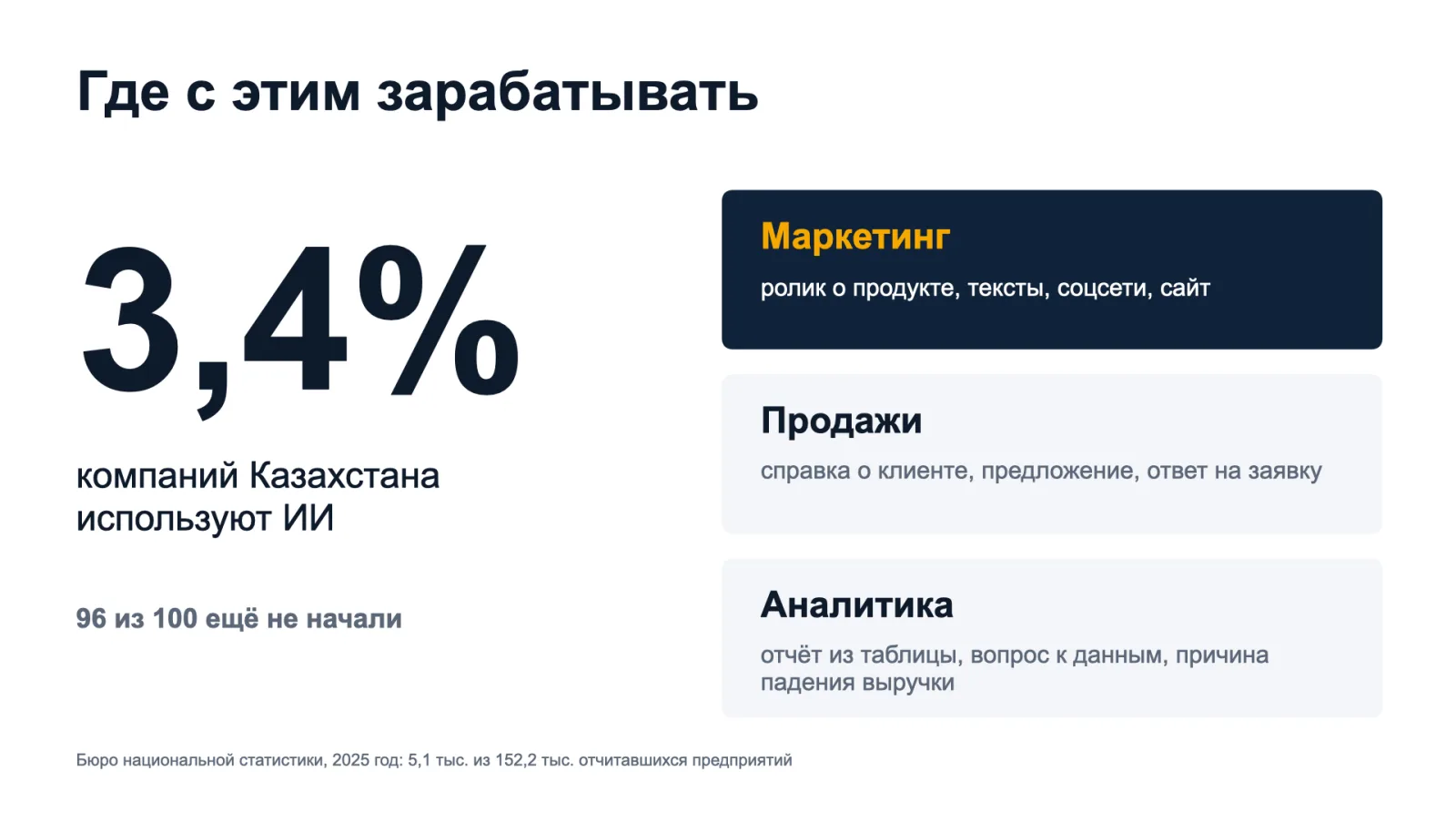
- Bureau of National Statistics · On the use of ICT in enterprises of the Republic of Kazakhstan — in 2025, 5.1 thousand of 152.2 thousand reporting organizations used AI, about 3.4%. Table, April 2026.
- Paul David · The Dynamo and the Computer — why the electric motor did not change factories right away. American Economic Review, 1990.
Where I write about this
About AI and how we are restructuring the company.